
Capture Beats in Monomorphic Ventricular Tachycardia
Jul 18, 2026Monomorphic ventricular tachycardia (VT) is normally a rhythm entirely controlled by a ventricular focus. Every QRS originates from tissue distal to the His–Purkinje system, giving the QRS its wide and uniform morphology. But occasionally, amid a run of wide-complex beats, you’ll see a normal-looking narrow QRS. This is the capture beat, a momentary victory of supraventricular conduction over the ongoing ventricular focus.
A capture beat is one of the most reliable ECG signs that the wide-complex tachycardia you’re looking at is ventricular rather than supraventricular with aberrancy.
1. The Electrophysiologic Setup: AV Dissociation
In monomorphic VT, the ventricles are depolarized by an ectopic focus independent of the atria. Therefore:
-
The atria continue to fire from the sinus node.
-
The AV node continues to conduct, but usually cannot penetrate the ventricle because it is already activated or refractory from ongoing VT.
-
This produces AV dissociation, the essential substrate for capture beats.
Atrial impulses march through the AV node at their normal rate, constantly probing the ventricular myocardium. Usually they find it refractory; occasionally, they get through.
2. What Is a Capture Beat?
A capture beat occurs when a single sinus impulse manages to conduct through the AV node and depolarize the ventricles before the next VT focus fires.
This produces:
-
A narrow QRS (or at least narrower compared to the wide VT QRS)
-
A QRS that resembles the patient’s baseline sinus morphology
-
A “normal-looking” beat embedded within a run of wide VT beats
Mechanism:
-
The ventricular myocardium happens to be in a moment of excitability.
-
A sinus impulse arrives during that window.
-
The impulse travels down the His–Purkinje system.
-
It captures the ventricles entirely, momentarily overriding the ventricular ectopic focus.
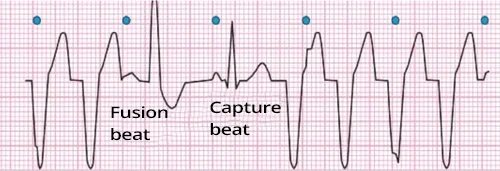
https://www.ecgbook.com/fusion-beat/
The key concept:
A capture beat is 100% supraventricular in origin, even though it lives inside a ventricular rhythm.
3. Fusion Beats: The Cousins of Capture Beats
Fusion beats occur when:
-
The sinus impulse partially activates the ventricle
at the same time -
The VT focus is also activating the ventricle
The result is a hybrid QRS:
-
Morphology intermediate between VT beats and sinus beats
-
Part of the complex looks narrow and Purkinje-driven
-
Part looks wide and ectopic
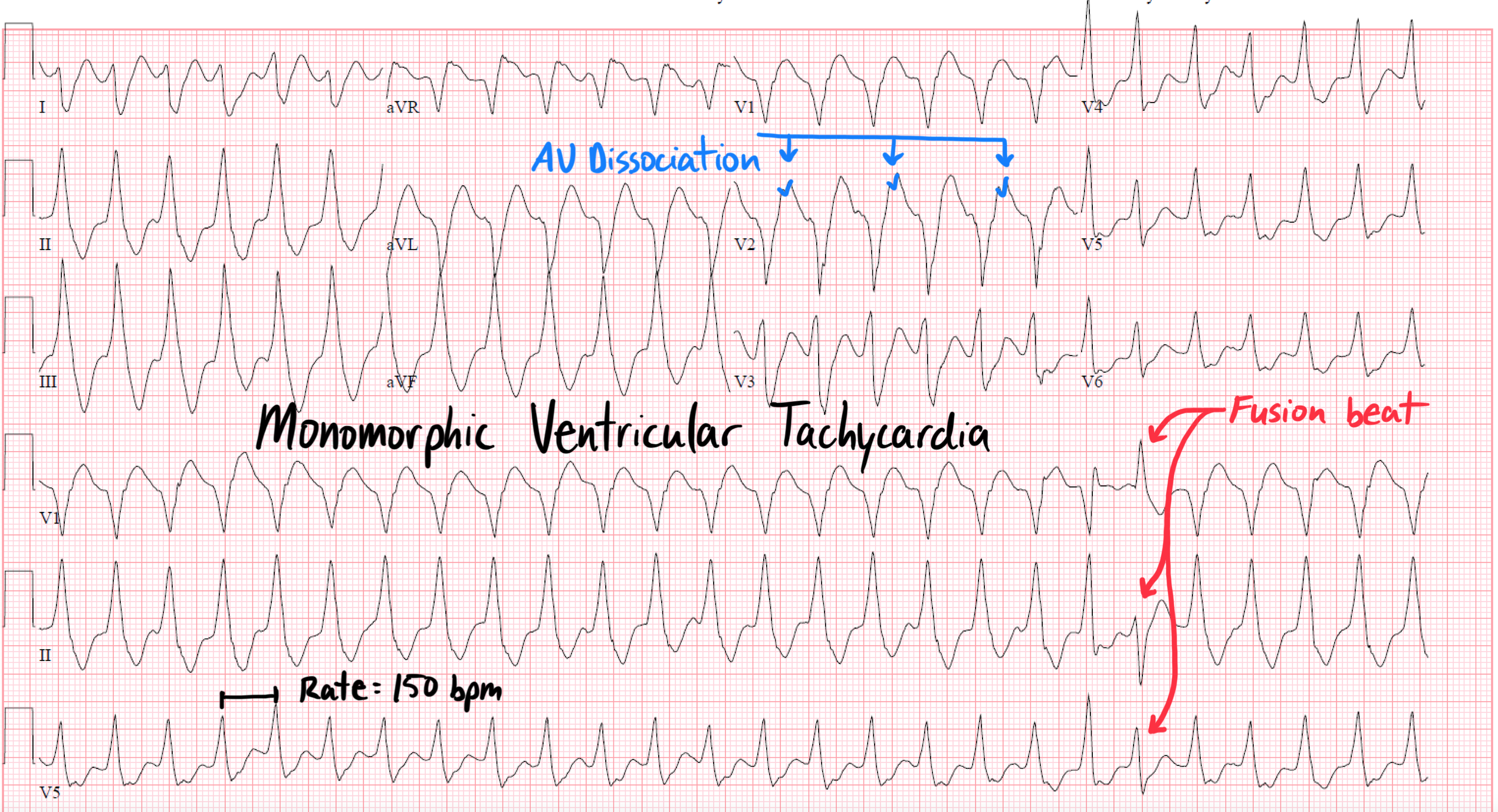
Fusion beats reinforce the same diagnosis: a supraventricular impulse is intermittently reaching the ventricles through an intact His–Purkinje system.
Enjoy this style of lecture and looking to learn more? Click below to learn more about how you can join my complete ECG course.
ECG With Reid Academy
Accredited by the AMA, AAPA, ANCC, ACPE & more.